Non-emergency claims can now take more than two years to process, The Australian reports. So, a woman who has been genuinely assaulted, and needs help with medical bills, counselling or moving house, waits in line behind tens of thousands of other claims, including the serial claimants collecting their fifth, sixth or ninth payout.
And Queensland is not alone. Every Australian state and territory runs its own victims of crime scheme, and several are heading the same way, if more slowly.
In Western Australia, applications have doubled in four years, from 5,612 in 2020-21 to 11,404 in 2024-25. Awards jumped 73 per cent in a single year to almost $120 million, roughly the same per head of population as Queensland. Family and domestic violence now accounts for 45 per cent of finalised claims, and 83 per cent of people receiving awards are women. (Queensland doesn't publish a gender breakdown of its payouts.) In WA, even breaching a restraining order, which can be as minor as a text message, can qualify for compensation if the victim claims 'mental and nervous shock'. Such claims rose 85 per cent in a single year. The WA scheme's own annual report flags "increasing incidents of attempted fraud".
Advertisement
In New South Wales, applications to the Victims Support Scheme rose 81 per cent in four years, from 24,205 to 43,697, and the bill for claims lodged but not yet paid has climbed to $557 million. In the ACT, applications are up 168 per cent since 2020-21.
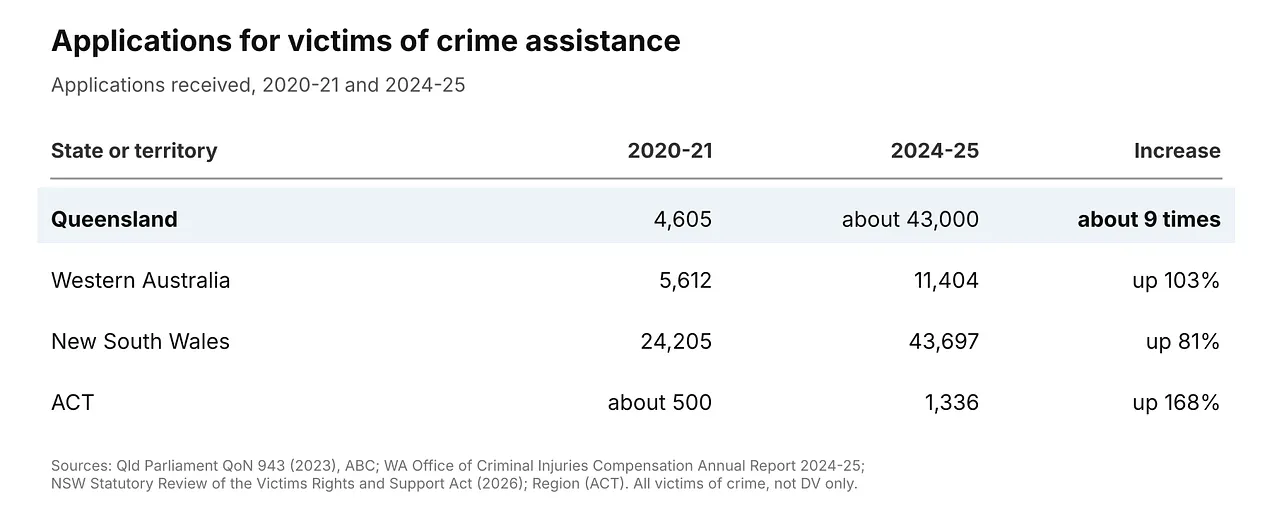
The states that have kept the lid on are those that still insist on a police report and a criminal offence and keep lump sums small. In Victoria, a typical domestic assault attracts a payment of no more than $1,300. South Australia pays the first $2,000 of a claim in full and only 75 per cent of anything above that.
Most of this money is never recovered. Governments can claw it back from the alleged perpetrator only if a criminal court finds him guilty, and most DV claims never get anywhere near a court. Back in 2012, the NSW Auditor-General found that of the $1.6 billion paid out since the state's scheme began in 1989, under 4 per cent had been recouped from offenders. Last year NSW recovered just $8 million, while applications ran at more than 40,000 a year.
When there is a finding of guilt, the bill can arrive years later. It can be for something as minor as breaching a restraining order, or the new offence of coercive control. In NSW the order can still be made even if the magistrate records no conviction. The man then has 28 days to object. If he doesn't, the debt goes to Revenue NSW, which can take the money from his wages or bank account.
One NSW man knows just how this works. During a bitter breakup, he was still living with his estranged partner in what he describes as a 'War of the Roses' siege, as they battled over their co-owned property. She made a string of allegations against him, some of which fell apart in court. He was convicted on one charge: he says he installed a camera for his own protection and was found guilty of recording an intimate image without consent. She was charged with assault, property damage and intimidation, and the judge remarked that she 'could easily be sitting on the other side of the Courtroom'.
Advertisement
Five years after his conviction, a letter arrived out of the blue. Victims Services had paid her $15,227, and now it wanted the money from him. It included a $10,000 'recognition payment', the category reserved for serious sexual assaults, such as those causing serious injury or involving a weapon. A further $5,000, the maximum, was for 'immediate needs' such as new locks or emergency relocation. Yet she applied nearly two years after the offence, by which time she had been living alone in their house, with everything in it, for months.
Nobody had asked him about any of this before the money was paid. The order was simply posted to the last address on file – luckily, he still lived there - giving him 28 days to object. He lodged a detailed objection. Victims Services is supposed to decide objections within 90 days. After 114 days he wrote again, pointing out that he was now entitled to go to the NSW Civil and Administrative Tribunal, where the department would have to justify the payment. Two days later the order was revoked. Victims Services never attempted to justify the payment.
Many men, he points out, wouldn't have the education or the confidence to fight. And the $15,227? As far as he knows, nobody has asked her to give it back.




 reddit this
 Del.icio.us

 Seed Newsvine
 StumbleUpon



