Is it any wonder men are opting out? That's the question I asked here on Substack last May, describing the young women so many men find on offer in today's marriage market: "miserable, anxious, politically radicalised, contemptuous of men, often sexually rejecting and trained to see menace in ordinary male behaviour."
I concluded many men were deciding these women were not worth having, with pollsters finding many young women distrust men and see them in a negative light:
They arrive at relationships pre-loaded with grievance, fluent in the language of red flags and emotional labour, primed by algorithms that have fed them a diet of male failure and female outrage since adolescence. They are, by their own account, anxious, miserable and politically furious.
Advertisement
That article, explaining why so many men are losing interest in both work and marriage, was viewed over 86,000 times. My comments were filled with men saying, "Yes. That's me."
But one question kept nagging at me. How did we get here? How did a generation of young women become so angry, so anxious, so hostile to the very men they claim to want?
There's no shortage of theories. Social psychologist Jonathan Haidt blames the smartphone: girls' anxiety and depression began soaring around 2012, just as Instagram took hold. Others point to the pandemic, to economic gloom, to universities steeping students in grievance politics, to years of #MeToo messaging teaching girls to see menace in ordinary male behaviour.
All of these play a part. But I want to suggest another factor, one that set the stage long before the first iPhone. Inspired by feminists like Betty Friedan who preached work as women's salvation, young women were encouraged to put marriage on hold: get the degree, build the career, see the world, settle down later. And so, they did. Without anyone quite noticing, we added an entire decade of dating into young adults' lives. Then along came the smartphone and the dating apps, and that decade became a brutal marketplace of seeking and rejecting, of dates that go nowhere and breakups that leave scars.
That decade has proved enormously costly, with profound consequences for our societies. Look at what has followed. Marriage – for generations the cornerstone of adult life – is in free fall, the Australian marriage rate more than halved in fifty years. Our birth rate has sunk to 1.48 babies per woman, the lowest ever recorded and far below the 2.1 needed simply to replace ourselves. In the United States, demographer Lyman Stone projects that one in four women now in their thirties and forties will never have children – most of them not by choice. Growing numbers of women will now face old age alone – often lonely, many of them poor. And the men, freed from the yoke of marriage that for centuries harnessed their ambition and their labour, are walking away from work as well as from women. This is not a private sorrow for a few unlucky individuals. It is the slow unravelling of the bargain upon which families, communities and economies have always depended.
Here are some statistics that might stop you in your tracks:
Advertisement
Women in Australia and New Zealand are freezing their eggs at record rates – more than double the number of four years ago, according to ANZARD, the register that tracks every IVF cycle in both countries. Ask the fertility doctors why, and they don't talk about glittering careers. The answer is much more basic: there's no man.
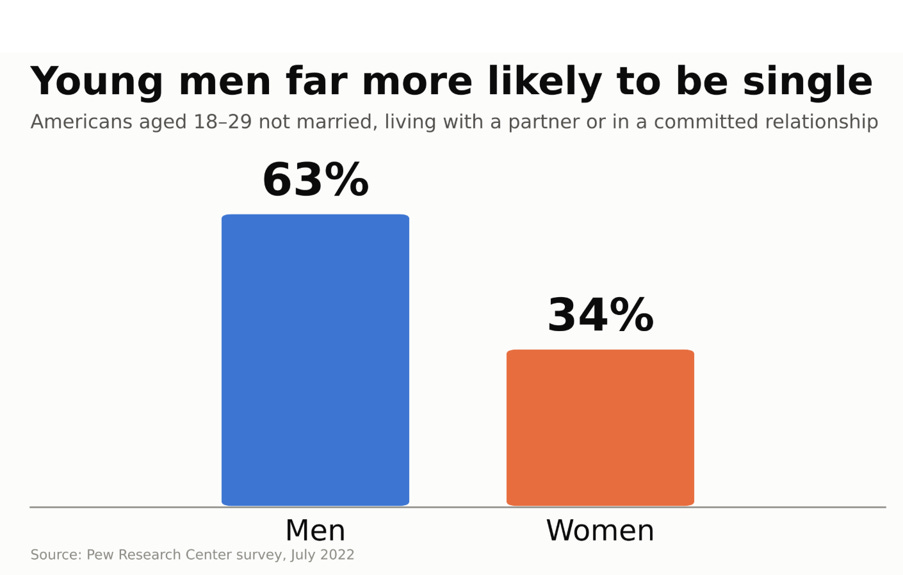
So where are all the men? A lot of them are home alone. The famous 2022 Pew survey found that 63% of American men under thirty were single – up from 51% just three years earlier. Not married, not living with anyone, not even in a relationship. And their female contemporaries? Only a third (34%) are in the same boat. Part of the gap probably reflects young women dating men over thirty – and perhaps some relationships she considers committed, he doesn't.
Discuss in our Forums
See what other readers are saying about this article!
Click here to read & post comments.
4 posts so far.




 reddit this
 Del.icio.us

 Seed Newsvine
 StumbleUpon



