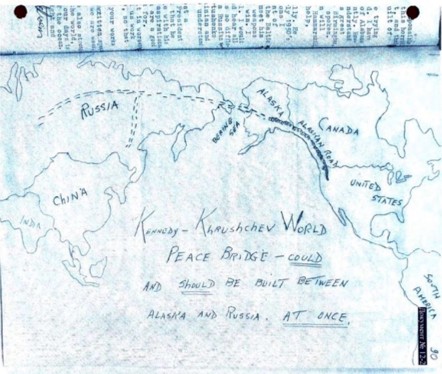
Figure 1: Original diagram of the Bering Strait from US-Soviet Peace Bridge, circa 1960s (https://www.indiatoday.in/world/us-news/story/what-super-secret-peace-bridge-why-russia-given-jfk-files-to-us-kennedy-khrushchev-siberia-trump-putin-2804602-2025-10-17)
The proposal to construct a railway and cargo tunnel beneath the Bering Strait, connecting Russia's Chukotka region with Alaska, recovers an old ambition to physically unite Eurasia and North America. In October 2025, Kirill Dmitriev, an advisor to Russian President Vladimir Putin and CEO of the Russian Direct Investment Fund (RDIF), extended a public invitation to Elon Musk's 'The Boring Company' to participate in the subject matter's project. Within this period, Dmitriev suggested such innovative construction methods could reduce the cost from more than USD 65 billion to below USD 8 billion, with completion possible 'within 8 years'. In June 2026, Dmitriev reiterated and publicised these figures of the named 'Putin-Trump Tunnel' proposal at the St. Petersburg International Economic Forum, with most recent renewals of the claim on X this month, October 2026.
Advertisement
Nevertheless, these figures remain preliminary estimates, and not an independently established project budget or construction schedule.
It must be heightened that the significance of this intercontinental strategy extends well beyond its engineering challenges. From the perspective of the Global Academy for Future Governance's (henceforth referred to as GAFG) Connectivity Doctrine, the Bering Strait is not simply a geographical obstacle in need of a technological solution. Instead, it is a potential entry point to a wider system of transport, energy, trade and institutional cooperation. One of which needs to be considered as such, especially as the project provides a possible new node within a global network of networks.
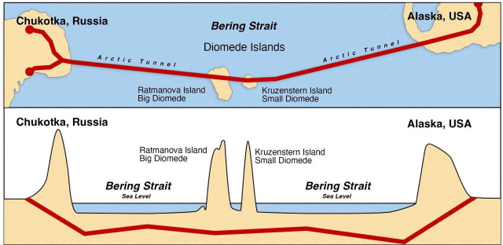
Figure 2: Visualised proposal of the aforementioned Bering Strait connection, (https://www.reuters.com/world/kremlin-envoy-proposes-putin-trump-tunnel-link-russia-us-2025-10-17/)
Beyond the tunnel: connecting systems
The Bering Strait is approximately 82 kilometres wide at its narrowest point, and the idea of connecting its shores has circulated for more than a century, surviving changing political circumstances and successive generational engineering ambition. The reasons to which the project has been preventive is not solely due to the difficulty in crossing the strait, but also the absence of the wider infrastructure and cooperation required to make such a crossing executable.
The concept of connecting both Eurasia and North America through the Bering Strait is older than the available technology that could attempt it. As highlighted in Figure 3, such connectivity has explored different avenues, each deeming the Bering Strait as a political and economic advantage. At this present juncture, the Bering Strait shows its credibility, however with necessitated further investigation of its use, and its external environmental consequences.
Advertisement
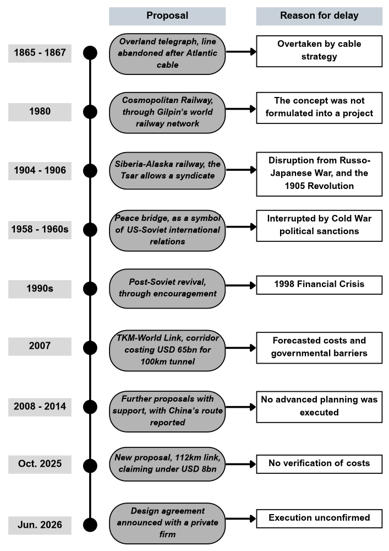
Figure 3: Visualisation of connectivity strategies over time concerning the Bering Strait (Joe Harvey Field, GAFG)
For example, extensive bilateral transport connections would be necessary. This includes railway access, freight terminals, energy supply, telecommunications, customs facilities, and upgraded logistics infrastructure. The sparse transport of networks within northeastern Russia and Alaska present a challenge in their own right, heightening that the tunnel would only be one component of a much larger undertaking.
Discuss in our Forums
See what other readers are saying about this article!
Click here to read & post comments.
1 post so far.




 reddit this
 Del.icio.us

 Seed Newsvine
 StumbleUpon