With the loss of transportation fuel supplies from Asian refineries resulting from the Iranian War and California's huge dependency, the 4th largest economy in the world is on the precipice of an unprecedented, self-inflicted logistical and national security catastrophe. Driven by adversarial state policies and aggressive litigation from activist groups, the state's domestic refining capacity has already been crippled, and has led to the most expensive transportation fuels in the nation for its California residents.
California is the 4th largest economy in the world and an "ENERGY ISLAND that is separated from the other 49 States by the Sierra Mountains. There are no pipelines over those prestigious mountains.
California demands 58 million gallons of transportation fuel DAILY:
Advertisement
If those transportation fuels are not made in California, they have to be made in refineries located in the Gulf or East Coast, or in foreign countries with gross polluting refineries and shipped across the Pacific Ocean via polluting tankers. However, the Ports of Los Angeles, Long Beach, and Oakland are NOT designed to import those humongous volumes of transportation fuels.
Without immediate federal intervention via the Defense Production Act, California, its neighboring states, and the U.S. military face the potential for a total supply chain collapse.
I. Policy-driven destruction: the timeline of a dying industry
A series of aggressive, adversarial state legislative and regulatory actions have systematically dismantled California's refining sector, stripping away 35% of the state's crude oil refining capacity and slashing gasoline and jet fuel production by 40% and 30% respectively:
- Assembly Bill X2-1 (ABX2-1):Signed in October 2024, this law mandated minimum fuel storage levels, driving up operating costs to unsustainable levels.
- The Phillips 66 Wilmington refinery closure (October 17, 2025):Forced by the state's regulatory climate, Phillips 66 shut down its Wilmington refinery, taking 139,000 barrels per day offline.
- The Valero Benicia refinery Exit (January 31, 2026):Burdened by a record $82 million fine and the new tank storage mandate, Valero took a staggering $1.1 billion loss to permanently shutter its Benicia refinery (135,000 barrels per day).
- The Marathon Martinez refinery & Phillips 66 Rodeo refinery Conversions (2023):Marathon and Phillips 66 converted facilities to renewable diesel, taking another 260,000 barrels per day of crude processing capacity offline.
II. Critical vulnerability: California on life support
California is already operating on borrowed time, kept afloat only by emergency inflows of transportation fuels from the rest of the nation:
Advertisement
- Unprecedented imports:In just the last two months, California has been forced to import more jet fuel from the Gulf and East Coasts, via ships through the Panama Canal, than in the past 36 years combined.
- Gasoline Surges:Over the past few months, the West Coast has imported more gasoline than in the last 15 years combined.
- Military Reserves Drained:Despite Gulf Coast refineries running at a grueling 98% capacity, California still required substantial emergency draws from the nation's military fuel storage reserves to prevent a systemic collapse and fuel rationing.
- Port vulnerability:The three busiest ports in America, located at Long Beach, Los Angeles, and Oakland are unable to support the supply chain for the humongous daily transportation fuel demand volumes within CA. The bulk of incoming transportation fuel from whatever source is being offloaded at the refinery docks, into storage tanks, and shipped out normally as if the refinery were still online. Actual port operations are threatened as stated later in this article
III. The industry warning: an irreversible threat
In early 2026, the state's remaining major refiners dispatched a series of desperate joint warnings to regulators, making it clear that California is on the verge of losing its entire refining industry:
- "I am extremely worried! I do believe we should declare a state of emergency in the state of California. If you close a refinery, it doesn't come back... if we close, we do not come back." - Andy Walz, Chevron Midstream and Downstream President (March 6, 2026)
- "Unless CARB puts in-state refineries on an equal footing with importers... we will be forced to address the viability of our in-state operations, along with every other refiner in the state." - PBF Energy (February 25, 2026)
- "CARB's proposal would further widen the cost disparity, forcing refineries to reconsider whether refinery operations in California remain viable... The net effect will be an increase in global greenhouse gas emissions [by relying on foreign imports with lower environmental standards]." - Marathon Petroleum (March 9, 2026)
IV. The environmental lawsuit: triggering the cliff edge
While a fragile, temporary compromise on Cap-and-Invest ("C&I") amendments briefly paused immediate shutdown plans, the environmental activist group "Communities for a Better Environment" is now suing the Air Board to force the withdrawal of this compromise.
If this lawsuit succeeds, PBF Energy, the smallest of the remaining seven operating refineries, will likely be forced to shutter its operations, triggering immediate and catastrophic deficits:
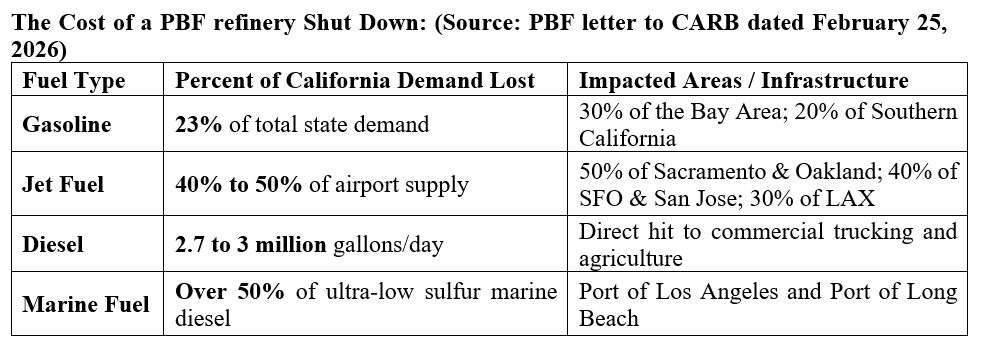
V. The ultimate threat: total west coast collapse
The equation is simple: if PBF shutters, gasoline imports will skyrocket to 60%+ and diesel/jet fuel imports will exceed 50%.
The solution: invoke the defense production act now
California's state policies have created an unacceptable national security threat to itself, neighboring states, and the country. Just as the Defense Production Actwas invoked to bring the Sable offshore oil platforms back online, the federal government must step in immediately to protect and preserve California's remaining refining infrastructure to support the humongous transportation fuel demands within the State.
- The Trigger Point:If just two more of the seven operating refineries shut down, California will face a complete logistical collapse.
- The Worst-Case Scenario:If all seven remaining refineries close, the West Coast's ports will cease operations, airports and military installations will shut down, and the food supply chain extending deep into the American heartland will be permanently compromised.
Discuss in our Forums
See what other readers are saying about this article!
Click here to read & post comments.




 reddit this
 Del.icio.us
 Seed Newsvine
 StumbleUpon

 Ronald Stein
 Mike Ariza


