In Tuesday’s federal budget, the government is widely expected to bring in changes to how investment properties are taxed, including negative gearing and the capital gains tax discount.
Ever since the Albanese government’s re-election, there have been growing calls to tax landlords more.
In March, a Senate committee report on the capital gains tax discount concluded:
Advertisement
there is evidence that the concessions provided by the capital gains tax discount, in combination with negative gearing, have skewed the ownership of housing away from owner-occupiers and towards investors.
That suggests rented housing is under-taxed, compared to owner-occupied housing. But is that actually true?
What landlords pay that homeowners don’t
Some federal and state taxes apply only to rented housing, and not to owner-occupied housing.
At a federal level, this includes personal income tax on net rental income and personal tax on capital gains from housing. At a state level, there are land taxes on investment properties. Owner-occupied homes are exempt.
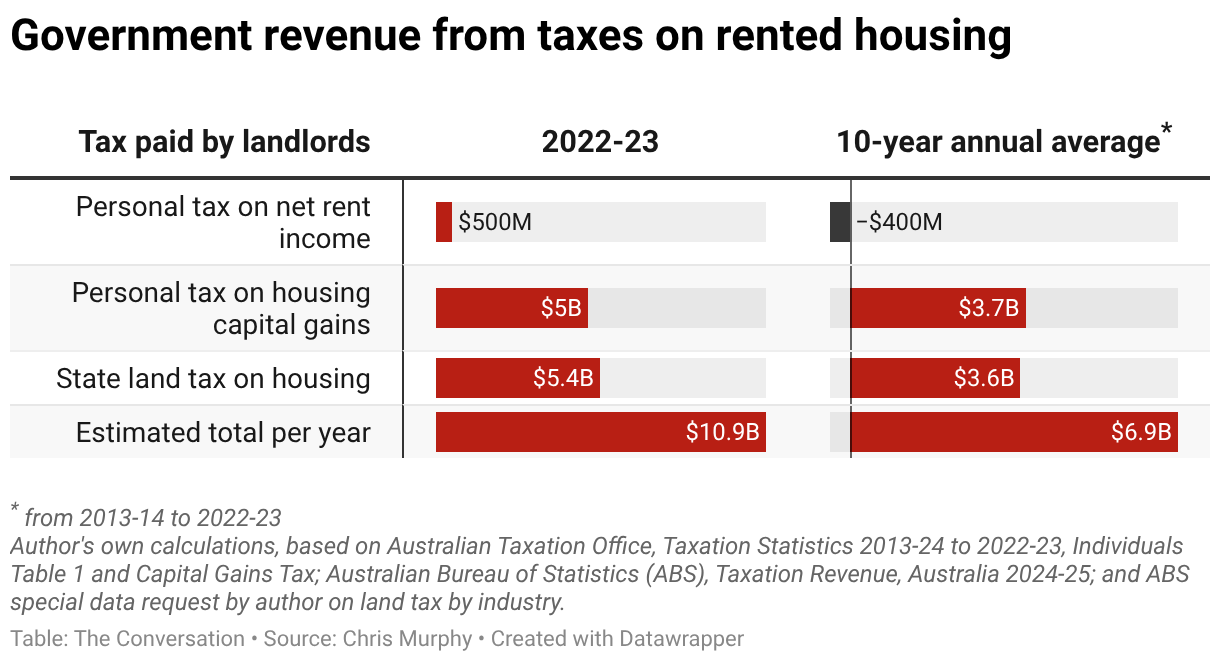
I’ve gone back through a decade of data from the Australian Taxation Office and the Australian Bureau of Statistics to estimate how much revenue these extra taxes on rented housing raised.
Advertisement
In 2022–23 (the most recent year we have complete tax statistics), I calculated landlords paid around A$500 million in personal income tax on their net rent income. However, their interest deductions were unusually low in 2022–23, because interest rates were unusually low.
To get a clearer idea of what happens under more typical circumstances, with higher interest rates, I calculated annual averages of tax payments, using tax data from 2013–14 through to 2022–23.
Over that decade, interest deductions were higher than in 2022–23, leading to net rent income being negative. As a result, instead of paying some tax on their net rent income as happened in 2022–23, landlords typically saved $400 million a year in tax from their net income.
Discuss in our Forums
See what other readers are saying about this article!
Click here to read & post comments.




 reddit this
 Del.icio.us
 Seed Newsvine
 StumbleUpon