Jim Chalmers’ proposed new CGT regime, and mooted changes to negative gearing, would amount to a tax on renters, retirees, savers, and entrepreneurs.
It would raise little revenue, and signal surrender on growing the economy and living within our means.
It certainly would not do anything for housing affordability.
Advertisement
Instead, it distracts from the real causes of the housing crisis: interest rates too low for too long, record immigration, government construction crowding out private sector construction, planning strangulation, alleged union featherbedding, and infrastructure bottlenecks.
Before the 2025 election my think tank, the Australian Institute for Progress, commissioned work from Adept Economics which predicted that removing the capital gains discount and negative gearing from rental housing would increase the average Australian rent by $83 a week, on top of natural increases.
That is because when you tax something more there is generally less of it, and when there is less of it and the same demand, the price rises.
Homeownership levels for people under 35 have fallen by around a quarter over the last 40 years, and the current housing crisis means it takes even longer to save a deposit. That pushes more people into renting, increasing demand for rental properties.
This policy would be a disaster for Australians under 30, a constituency that has faithfully voted Labor and Greens all their voting life.
The government would argue there will be a payoff for home buyers because it will stop investors competing with them for stock. Even if supply were not the overall determinant of house prices, the truth is that it is homeowners who compete with investors, not the other way around.
Advertisement
Part of the reason for high house prices is that the tax system advantages homeowners, and this advantage is capitalised into the purchase price.
Homeowners do not pay capital gains tax at all, and that is where most of the return is in residential real estate.
While investors might get a deduction on interest and other expenses, this is offset against earnings, which are taxed as soon as they turn positive.
The homeowner does not get any deductions, but neither do they pay tax on the ‘imputed’ rent to themselves. This is a huge benefit, particularly for top-bracket taxpayers in large houses, and it is tax-free.
This is not the only area where the government seems confused.
While looking at upping the tax on mum and dad investors, they have halved the tax on foreign Managed Investment Trusts (MITs) to encourage them to provide build-to-rent (BTR) accommodation.
While mum and dad investors could end up paying capital gains at a rate approaching 47 per cent over time, properly structured MITs will face a tax rate of only 15 per cent.
Fiddling with capital gains will not only affect housing. It will also affect shares and superannuation, putting retirees and savers in the gun.
This is not just about profits foregone. Share portfolios are actively adjusted to manage risk. If the CGT discount goes, it becomes 50 per cent more expensive to manage that risk, and it will take longer for a retirement nest egg to grow to a level that can support someone in old age.
Or perhaps the saver falls short of self-sufficiency and becomes a pensioner, clawing some of the government’s capital gains tax back through social welfare.
Then there is the effect on entrepreneurs. It is fair to say the entrepreneur is not really interested in the income from an idea, but the potential capital payoff. So too are the investors every entrepreneur needs to turn an idea into a potential unicorn.
This becomes even more true the earlier the stage of investment. If you increase CGT by around 50 per cent you have just increased the cost of capital and the hurdle rate and made other jurisdictions more attractive.
It is not as though Australia’s CGT rate is particularly low. The OECD puts us 13th highest for CGT among the 33 countries they measure. This is above average, and there are 13 countries on that list that do not charge CGT at all. Those 13 include New Zealand, France, Singapore, and Poland.
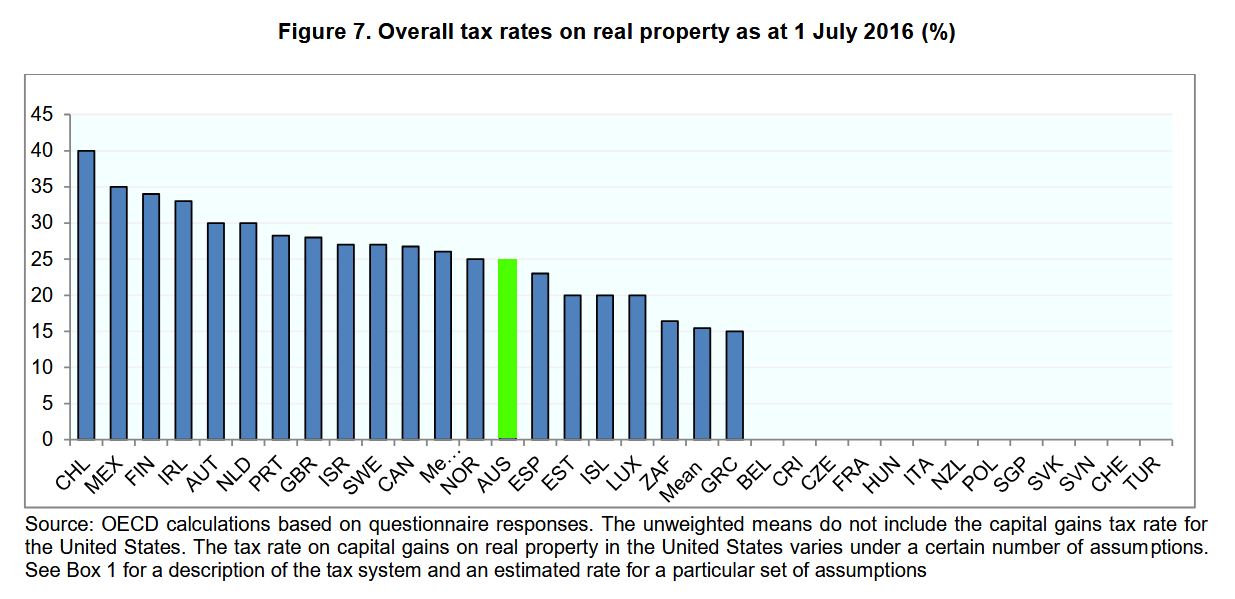
Source: OECD Taxation Working Papers No. 34 Statutory tax rates on dividends, interest and capital gains: The debt equity bias at the personal level. https://www.oecd.org/content/dam/oecd/en/publications/reports/2018/02/statutory-tax-rates-on-dividends-interest-and-capital-gains_1746a468/1aa2825f-en.pdf
Australia has one of the least diverse economies in the world. Chalmers is about to make it harder for the mining industry we rely on to attract capital, at the same time as he makes it harder for the new industries that might replace the rivers of cash from iron ore, gold, and coal.
Increasing CGT will do less than nothing for productivity and is only ‘necessary’ because the government refuses to live within its means.
It looks attractive because it is assumed to only penalise greedy capitalists. Look more closely and it will penalise almost all of us.




 reddit this
 Del.icio.us
 Seed Newsvine
 StumbleUpon