The second feature is perhaps a surprise and counterintuitive. In the 50 years from 1974 to 2024, the US share has more or less held steady between 25 and 30 percent of the world's GDP. But this is not true of the rest of the major Western economies. The decline in the G7 dominance of the world economy is due not so much to the US as to the other six (G6 in the two figures). On market exchange rates, the G7 were still wealthier than the BRICS with 44.3 and 24.6 percent of world GDP in 2024, respectively (Figure 1). But the five-member BRICS have a larger share (24.6 percent) of global output than the G6 (18.1 percent) even in market exchange rates.
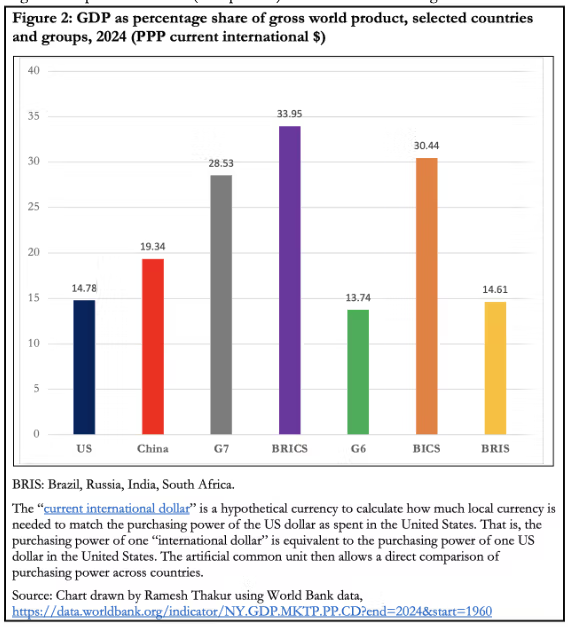
Third, the rise of the rest is even more dramatic when we switch from market exchange rates to purchasing power parity (PPP) dollars for 2024 (Figure 2). On this measure the BRICS-5 are significantly ahead of the G7 (34:28.5 percent) and 2.5 times that of the G6. Furthermore, if we take away China from the BRICS group, then the BRIS-4 have a higher combined share than the G6 (14.6:13.7 percent).
Advertisement
Fourth, as anticipated in the preceding paragraph, the major driver of the rest is the phenomenal economic performance of China. On market exchange rates, it has climbed from between 1.6 and 3.5 percent of world GDP in 1961–90 to 17 percent in the 2020s as the world's second biggest economy (Figure 1). The rise is even more startling in PPP dollars. On this measure, China's share of world GDP is nearly five percent more than that of the US (Figure 2).
The Western democracies are suffering blowback from their liberal conceit during the decades in which their dominance enabled them to design and operate the control knobs of the global governance institutions. When illiberal states that were brought inside the international institutional fold grew powerful, instead of experiencing an efflorescence of liberalisation in their own domestic domains they effectively sabotaged the international liberal enterprise.
The West's discomfort level has risen with the Global South's 'geopolitical and geohistorical' voice being raised with increasing assertiveness in world affairs at a time of multipolar multilateralism. As US Secretary of State-designate Marco Rubio put it during his Senate confirmation hearing on 15 January 2025: 'The post-war global order is not just obsolete, it is now a weapon being used against us.'
Discuss in our Forums
See what other readers are saying about this article!
Click here to read & post comments.




 reddit this
 Del.icio.us
 Seed Newsvine
 StumbleUpon


