Thus, an international judicial panel has taken the place of states in effectively developing a new legal framework or treaty with which it considers states must comply. Who exactly will enforce the court's opinion on the geopolitical heavyweights like China, Russia, and America? Furthermore, the judges' reasoning sets a precedent for the same argument to be repeated in a future pandemic contingency, even for states that may have opted out of the WHO pandemic accords.
The scope for this will be virtually unlimited because of the related pattern of judicial behaviour whereby judges have been flagrantly ignoring both the text of the relevant laws and the democratic will of parliaments giving effect to the democratic preference of voters, all in the name of conventions and treaties being 'living instruments.' Lord Jonathan Sumption, a former justice of the UK Supreme Court, holds that 'The living instrument doctrine is nothing less than a claim to legislative powers without boundaries.' This is a departure from international law, which binds states only to the specific language of the treaties that they have signed. They are also 'impossible to reconcile with basic principles of democratic government,' with courts effectively arguing that their decisions prevail over choices made by voters, he says.
On 14 November, possibly emboldened by the ICJ opinion on climate liability, the UN Special Rapporteur on the Human Right to a Clean, Healthy and Sustainable Environment, Astrid Puentes Riaño, applied to join three Australian Federal Court cases in an amicus curiae capacity. The cases challenge a government decision to authorise Woodside Energy to continue operating its North West Shelf liquefied natural gas project.
Advertisement
I first began to wonder about the relationship between national and international law after the 1971 Bangladesh war, in which Pakistan suffered a heavy military defeat by India. India's treatment of 90,000 Pakistani prisoners of war was governed by the Geneva Convention, meaning they enjoyed superior international standards of treatment compared to ordinary prisoners in Indian jails. Today, the scale of illegal immigrants and asylum seekers entering the UK threatens to overwhelm the public finances as the UK has the responsibility to ensure their welfare and security under justiciable European and international conventions.
Conventions once signed are notoriously difficult to 'unsign' and exit. This has several damaging consequences for Western countries in particular that generally honour international commitments. If so required, they incorporate international legal obligations into domestic law which provides the entry point for lawfare activists to challenge, at considerable public cost and lengthy appeals procedures, efforts to impose government controls on flows of people at scale, or make policy trade-offs between emission reductions, energy security, and affordability, or even foreign policy trade-offs between the obligations of the International Criminal Court and bilateral relations with important partners and allies. In future, the pandemic accords could easily frustrate the efforts of governments to govern. But there are any number of countries where international legal obligations have exactly zero prospect of being enforced in domestic courts.
International enforcement has to rely on the UN Security Council, and only on that body. But five countries were granted permanent membership of the Council and given the power to veto any enforcement action they disliked, either against themselves or against anyone else that enjoys their patronage. This gives virtual blanket immunity to the five and all those they choose to protect.
They also get away with bullying behaviour towards weaker countries, allies (Soviet invasions of Hungary and Czechoslovakia in 1956 and 1968), as well as adversaries (Ukraine in 2022, NATO bombing of Serbia in 1999, US invasion of Iraq in 2003). To punish Russia for invading Ukraine, the US and Europe imposed sanctions. As Russian oil flooded the world market at heavily discounted prices to those prepared to buy, India's purchase of Russian crude oil skyrocketed to meet the energy needs of desperately poor people. Re-exporting the oil after refining it also helped to stabilise the world oil market. This year Trump imposed punitive tariffs on India of 50 percent, even though there is no international law that India has violated.
The liberal international order, which was established by the US-led West that dominated the world's geopolitical, legal, financial, trade, and technological architecture, is crumbling. The West embedded the norms and institutions that came to define legitimate state behaviour. The hubris that afflicted the West with victory in the Cold War and belief in the end of history encouraged the empowerment of institutions of global governance across a broad suite of policy domains with liberal assumptions and ambitions. The result was a dense structure of institutions that substituted global technocratic authority for national democratic accountability.
However, as wealth and power shifted from the West to the East, the rising powers asserted the right to a commensurate share in the design and control of global governance institutions. For the first time in centuries, it seems, the dominant global hegemon could come from outside the circle of the Anglosphere countries, not be a liberal democracy nor a market economy, and not be English-speaking. This has generated unease and discomfort in most Western countries worried about an axis of autocracies.
Advertisement
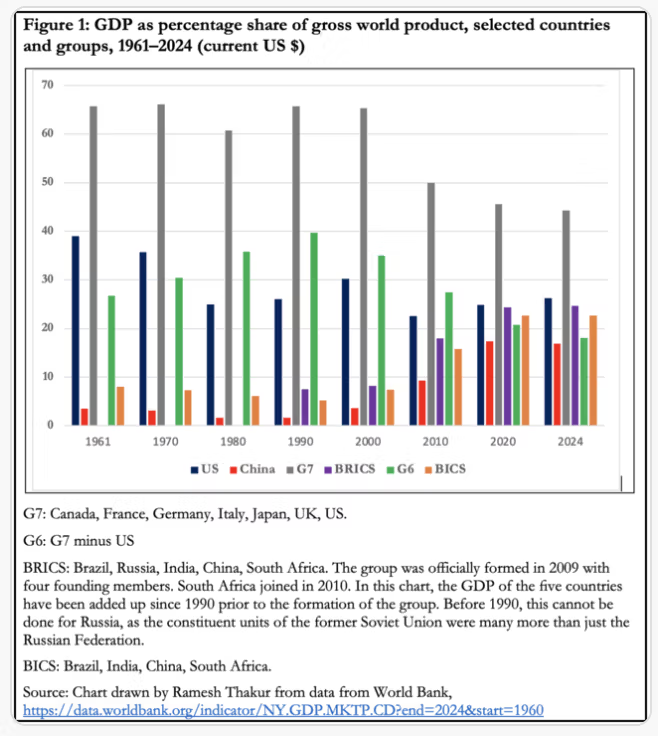
The BRICS grouping of emerging market economies (Brazil, Russia, India, China, South Africa) accounts for a larger share of the world's economic output in purchasing power parity (PPP) dollars than the G7 group of industrialised countries (Canada, France, Germany, Italy, Japan, UK, USA). BRICS has now grown with the addition of Egypt, Ethiopia, Indonesia, and the UAE in 2025. As an article in the Financial Times put it: 'This is the hour of the Global South.'
Figures 1 and 2 map the rise of the rest in a visual presentation. There are four important features to note. First, the dominance of the US in the decades after the Second World War was exceptional. In this period, the US accounted for between 35-40 percent of global economic output.




 reddit this
 Del.icio.us
 Seed Newsvine
 StumbleUpon


