These are statistics for all of Australia. They are preferable to data for the NEM (National Electricity Market) alone, which cover only 80 – 85% of Australia's total electricity generation, mainly the East Coast Grid. Many commentators like using NEM data because of their availability in real time. But they are only partial.
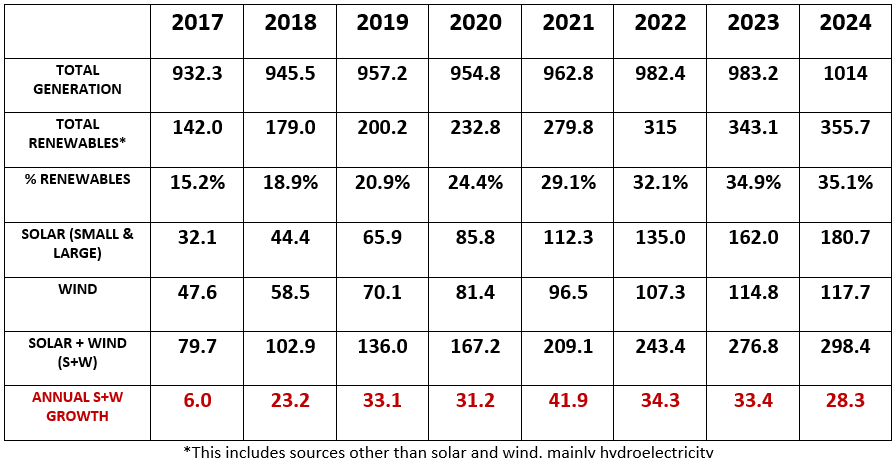
Australia's Renewables Generation 2017 to 2024, PJ
Advertisement
National statistics also happen to use the energy unit I regard as the most convenient for these purposes in terms of manageable numbers, the petajoule (PJ). 1 PJ = 1 x 10¹⁵ joules. Some prefer units more "traditional" for electricity, like the terawatt-hour (1 TWh = 3.6 PJ). Online websites now make conversion from one unit to another very simple.
The last two rows of the table, "SOLAR + WIND", are composites of the original data. They deserve a special place as they reflect exactly where growth in Australia's clean energy is occurring.
The bottom row, in red, is the key to describing and interpreting Australia's clean energy growth rates. One can conclude from that row that incremental growth in clean electricity output since 2017, from solar and wind energy, has been modest and fairly steady. It shows no significant tendency towards rising or falling. Average growth over seven years has been approximately 32 PJ per year. In relation to Australia's total annual generation of about 1000 PJ per year (top row) that's a growth rate of 3%.
The boasting and bluster one sees for renewables growth in Australia turns out to be referring to growth of 3%! It's defective. The real issue is whether the defects come from ignorance or fabrication.
The one thing that's certain is how widespread is the misunderstanding of renewables growth rate. Today ChatGPT tells me unequivocally that Australia's renewable energy output is growing "fast". That's a clear measure of how firmly embedded in the Australian mindset is the flood of nonsense fed to Australians by governments and the renewables lobby. Propaganda still works.
Why haven't others noticed the conspicuous deficiencies and inconsistencies outlined here. Politicians are of course forced by their jobs to be stuck in ruts. But surely some of the eminent scientists involved in energy matters have noticed. I have broached the subject with a few. They shrug their shoulders. It's a mystery.
Advertisement
One final calculation closes the argument. What is the correct ultimate clean energy target appropriate for completing Australia's energy transition? And how long will it take to hit it?
This topic needs more attention. Estimates must be rough because several large fossil-fuel based energy-intensive industries still cannot switch to electricity, so we have no real knowledge of what their electricity consumption will be.
I have made a rough estimate, based on analogies, that a future all-electric economy would need to consume around 2.5 times present electricity generation. The existence of other similar estimates is encouraging but it would be wrong to suggest there's a consensus.
Discuss in our Forums
See what other readers are saying about this article!
Click here to read & post comments.
10 posts so far.




 reddit this
 Del.icio.us
 Seed Newsvine
 StumbleUpon


