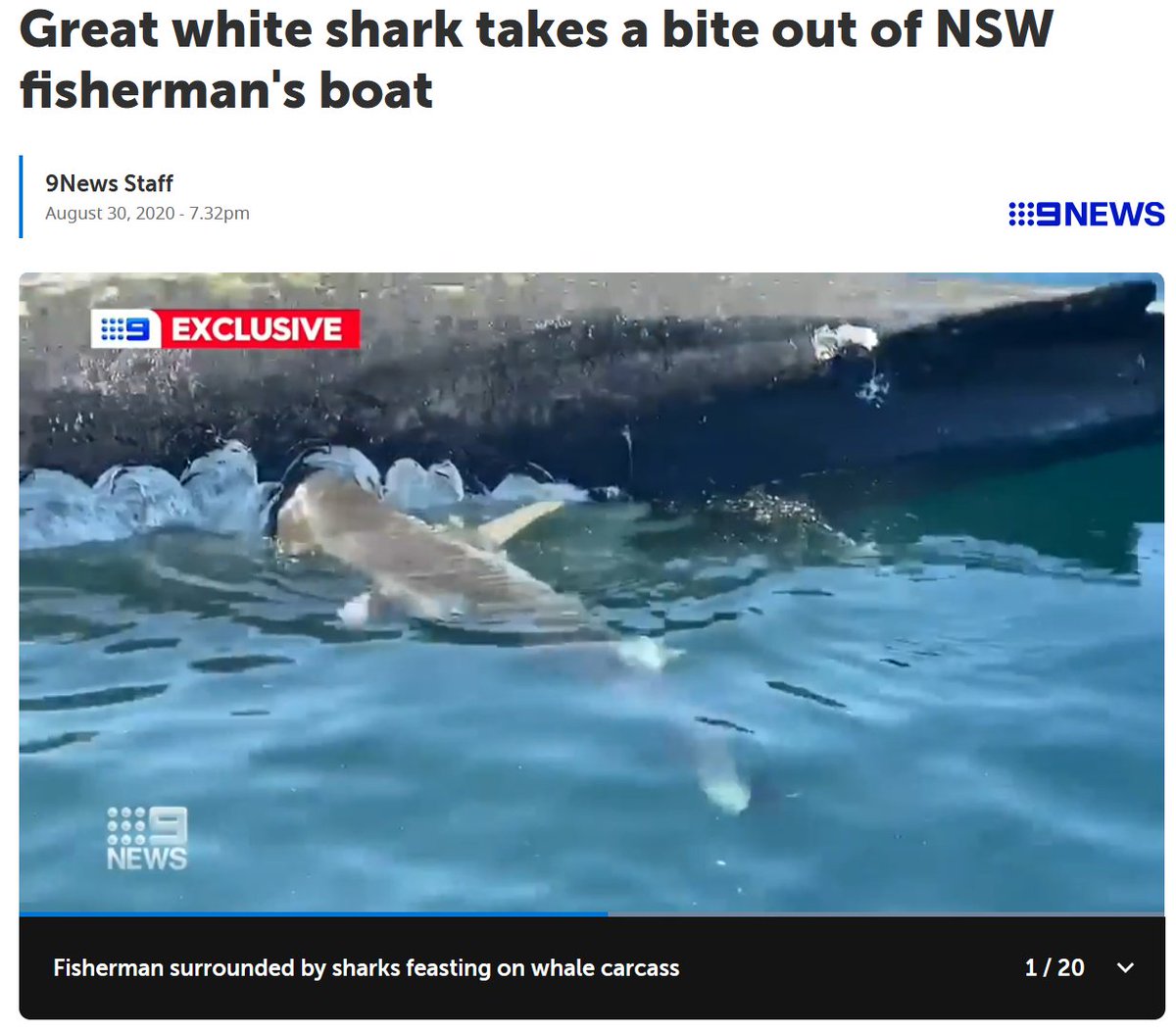
In August 2020 some fishermen off Forster went to have a look at a dead whale.
More than a dozen sharks were feeding on it, including great whites and tiger sharks.
Advertisement
Screen shot from Nine News
Then one of the great whites left the whale and had a go at the fishermen's outboard propeller.
It made me wonder about something I have wondered about for years.
Have we inadvertently bred more great white sharks by saving the humpback whale?
Before commercial whaling there were perhaps 30,000 humpbacks in the east Australian population. By the early 1960s they had been reduced almost to extinction.
Now there are more than 50,000, possibly 60,000, migrating up and down Australia's east coast each year.
Advertisement
That is a spectacular conservation success.
But ecosystems don't contain isolated species. Change one thing dramatically and other things change with it.
Consider the amount of food those whales represent.
Take 50,000 humpbacks and assume annual mortality of 1.5%. That's about 750 dead whales a year somewhere across their migratory range.
An adult humpback weighs roughly 25-30 tonnes. Mortality will include calves and juveniles, so use a conservative average carcass weight of 20-25 tonnes.
That gives roughly 15,000-19,000 tonnes of dead whale biomass a year.
Perhaps a third of an adult humpback's mass can be blubber. On those assumptions we're talking of something of the order of 5,000-6,000 tonnes of extremely energy-rich blubber each year, as well as thousands of tonnes of muscle and organs.
Obviously not all those whales die off NSW or Queensland, and sharks don't get all the carcasses.
But the scale is interesting.
Experimental estimates of great-white metabolism suggest 30 kg of whale blubber could provide around 15 days' energy for a roughly one-tonne white shark.
That means about 730 kg could supply a year's energy.
So 6,000 tonnes of blubber contains the energy equivalent of more than 8,000 one-tonne great-white "shark years".
The sharks plainly don't get anything like all of that.
But give them just:
1% = energy for ~80 large whites
5% = ~400
10% = ~800
And if only a quarter of the whale deaths occur where east-coast whites can exploit them, 5% of that resource could still represent something like 100 additional large-shark-years of food.
These are not estimates of how many extra sharks there actually are. They show the scale of the potential additional carrying capacity.
There's another important point.
The whales aren't simply recycling food already present off NSW.
They feed principally in Antarctic waters, accumulate vast energy reserves, then carry that energy thousands of kilometres north while largely fasting.
So every year tens of thousands of humpbacks effectively import Antarctic biological energy into the east Australian coastal ecosystem.
It would be surprising if adding an energy flow on that scale had no ecological consequences.
And we already know great whites exploit it. Scientists have documented whites aggregating around and feeding on whale carcasses off NSW.
But whales probably aren't the original reason for the seasonal movement of sharks.
The east coast already has a moving winter food chain. Sea mullet form huge schools and migrate north. Australian salmon move and aggregate seasonally. Tailor migrate as well. Those fish are themselves important prey for white sharks.
So perhaps the whales have not created a shark migration.
Perhaps they've supercharged an existing one.
A great white following mullet or salmon still has to hunt them. A dead humpback is something quite different: a stationary blubber buffet, potentially tens of tonnes of meat and fat concentrated in one place and available to multiple large sharks.
A shark already travelling the coastal food highway now has access not just to moving schools of fish, but to the occasional carcass carrying an extraordinary quantity of Antarctic energy.
And there is an intriguing bit of circumstantial evidence.
NSW white-shark attacks averaged about 2.1 per year between 2000 and 2014.
From 2015 to 2021 they averaged 5.3.
Exclude the extraordinary 10 attacks in 2015 and the 2016-21 average is still 4.5, more than double the earlier rate.
Even more interestingly, the NSW shark-meshing program, which has been operating at broadly the same beaches for decades, reported that white-shark catches after 2015/16 were consistently around three to five times higher than during the preceding period.
That doesn't prove there are three to five times as many great whites. They may simply be spending more time close to the NSW coast.
But that possibility is just as interesting.
White sharks are extraordinarily mobile. Their seasonal movements overlap substantially with whale migration and with the seasonal migrations of large schooling fish.
So here's my provisional hypothesis.
The recovery of the east Australian humpback population has injected a huge new source of imported energy into an existing seasonal coastal food highway. That has increased either the number of great white sharks the ecosystem can support, the amount of time they spend near the east Australian coast, or both.
It is only a hypothesis. There are plenty of competing explanations: protection of white sharks themselves, changes in fish stocks, water temperature, ocean currents and changes in shark behaviour or distribution.
But it is testable.
And there is a policy sting in the tail.
The great white remains federally listed as Vulnerable. The estimate usually quoted for the eastern Australasian population is about 5,460 animals, including only around 750 adults, based on work published in 2018.
Yet NSW has simultaneously been catching and detecting whites in numbers that seem difficult to reconcile intuitively with the picture many people have of an animal hovering on the edge of extinction.
Perhaps the science still supports that status.
But we ought to find out.
Because it would be a wonderful ecological irony if one consequence of rescuing the humpback whale from extinction was that we also helped rescue the great white shark.
And if we have, there comes a point at which conservation policy has to notice success.
If great whites are no longer genuinely threatened, and their increased abundance or changed behaviour is imposing a significant risk on people, then we should at least be prepared to ask the question conservationists won't like:
Have we reached the point where some targeted culling of great whites should be back on the table?




 reddit this
 Del.icio.us
 Seed Newsvine
 StumbleUpon