Spending, though, is not the same as a network. The harder question is whether track built to different national standards, at different speeds, and under different signalling and safety regimes behaves as one system once trains cross a border. Line density and the maximum speed permitted by existing infrastructure still vary sharply across Europe, so a train running at full speed in one country can slow to a crawl the moment it reaches older, lower-capacity track across the border. This is the same insight the Connectivity Doctrine applied to Africa’s corridors, turned inward on Europe itself: interoperability, not physical capacity, is the binding constraint.
Gibraltar makes the point unusually well. A 2025 feasibility study confirmed that a rail tunnel beneath the Strait, finally linking the European and African rail networks through TEN-T, is technically achievable, while Morocco’s own Atlantic strategy offers an alternative in the form of a network hub, moving cargo from Tanger Med onto rail and coastal shipping toward Dakhla. As Dr. Messias and Dr. Argillander pointed out in the recent GAFG Policy Brief: “gateways link places while network hubs link systems, and either version of Gibraltar’s future will only be as useful as the density, speed and interoperability of the European track it ultimately feeds into”.
The same logic holds for passengers, and here aviation offers a useful comparison. Long-haul flying and Europe’s Island connection will always need aircraft, and the research under way to cut aviation’s environmental footprint, from efficient airframe concepts such as the Z-4 prototype to the propulsion work associated with Dr. Ilham Habibie, deserves continued support. But even should such technologies succeed commercially, they are unlikely to match the energy efficiency of electrified rail over the distance that makes up most continental European travel. Given how compact the continent actually is, a large share of short-haul flying could in principle be shifted onto fast, reliable and, where necessary, subsidized rail service, not to eliminate aviation but to let each mode carry the traffic it is genuinely suited for, while cutting kerosene demand, easing pressure on crowded airports and reinforcing exactly the kind of structural resilience the Decoupling Doctrine is meant to deliver.
Advertisement
The railway, in other words, has quietly returned to geopolitics, even though Europe’s own record with it is rather uneven. The continent pioneered the technologies that transformed modern rail transport. France demonstrated the commercial viability of high-speed rail through the TGV. Germany became one of the pioneers of magnetic-levitation technology. Italy and Spain developed some of the world's most advanced tilting train systems.
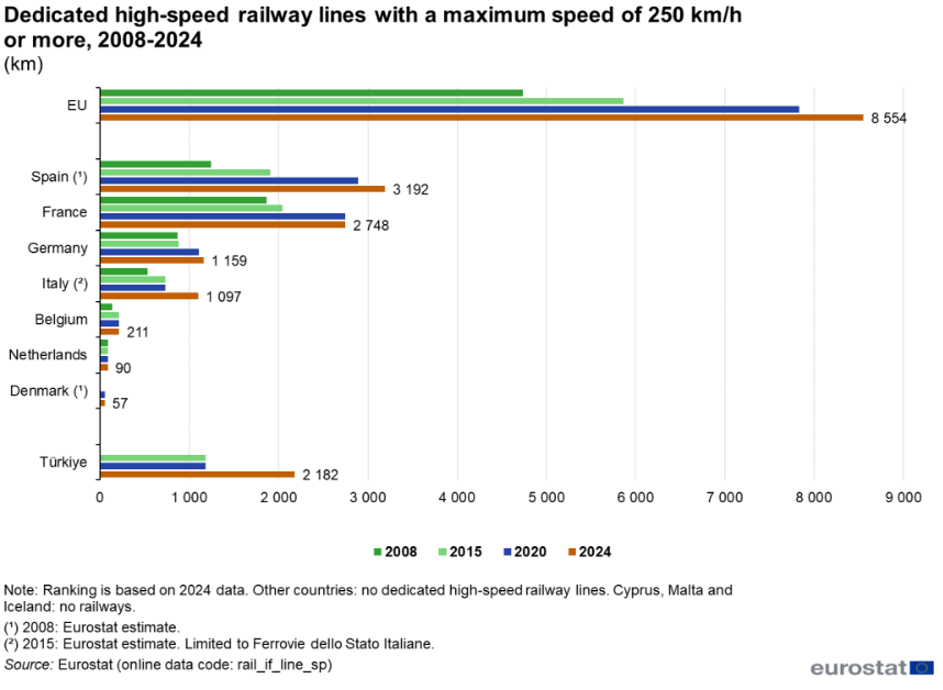
Figure: Dedicated high-speed railway lines with a maximum speed of 250 km/h or more, 2008-2024 (Eurostat)
Yet the first commercially successful high-speed maglev line entered service in Shanghai, not in Europe. Invention, on its own, is no longer a strategic advantage; deployment at continental scale is.
This is why the European debate over TEN-T, military mobility, strategic autonomy and the competitiveness agenda highlighted by the Draghi Report should be viewed as parts of a single strategic project rather than isolated policy discussions. Each recognises, from a different perspective, that Europe's future competitiveness depends upon the quality of its internal connectivity.
This perspective also resonates with the work of Mario Holzner, Executive Director of the GAFG partner institution, Vienna Institute for International Economic Studies (wiiw), whose analyses have consistently argued that modern, integrated railway infrastructure is not merely a transport investment but a cornerstone of Europe's competitiveness, territorial cohesion and long-term economic resilience. His work reinforces the growing recognition that Europe's railways should be understood as a cornerstone of competitiveness and territorial cohesion rather than merely another transport investment.
Advertisement
For too long, Europe has treated railways as another transport sector competing for budgetary resources against roads or airports. Rail should increasingly become the backbone around which continental mobility is organised: aviation remains indispensable for intercontinental travel, road transport will always provide the first and last kilometres, and maritime transport will continue to dominate global commerce.
But within continental Europe, rail should become the default strategic option. The objective is not to prohibit flying or driving. It is to reserve each transport mode for the tasks at which it performs best while allowing rail to assume the central role for medium-distance passenger travel and continental freight.
That is not nostalgia. It is geopolitical realism. Europe's first great integration project was institutional. Its second was monetary. Its third must be physical.




 reddit this
 Del.icio.us
 Seed Newsvine
 StumbleUpon