On Line Opinion is the only Australian site where you get all sides of the story. We don't charge, but we need your support. Here�s how you can help.
On Line Opinion is a not-for-profit publication and relies on the
generosity of its sponsors, editors and contributors. If you would
like to help, contact us.
___________
Casting Lupita Nyong’o as Helen and Elliot Page as Sinon the soldier were bold and exciting choices in Christopher Nolan’s The Odyssey.
Both signalled a departure from conventional, hyper-masculine Hollywood treatments of Greek myth. The comments of Elon Musk and many others on X confirmed Nolan’s success in that regard.
But as a scholar of ancient Greek literature and culture, I found the film disappoints in its portrayal of women.
Advertisement
Nolan’s women are (mostly) strong independent characters central to his anti-war theme. However, they play singular roles — wife, mother, caregiver, queen, witch — that lack the sexual and intellectual complexity of Homer’s poem. Their desires, agency and choices are either not as vibrant or lost.
Nolan’s Penelope knows the powerlessness of a queen whose husband has been absent for years, and whose kingdom is threatened by men seeking to take his place.
She uses her skill as a weaver to delay the suitors pressuring her to remarry, claiming she must finish weaving a burial shroud for her father-in-law while secretly undoing her work each night.
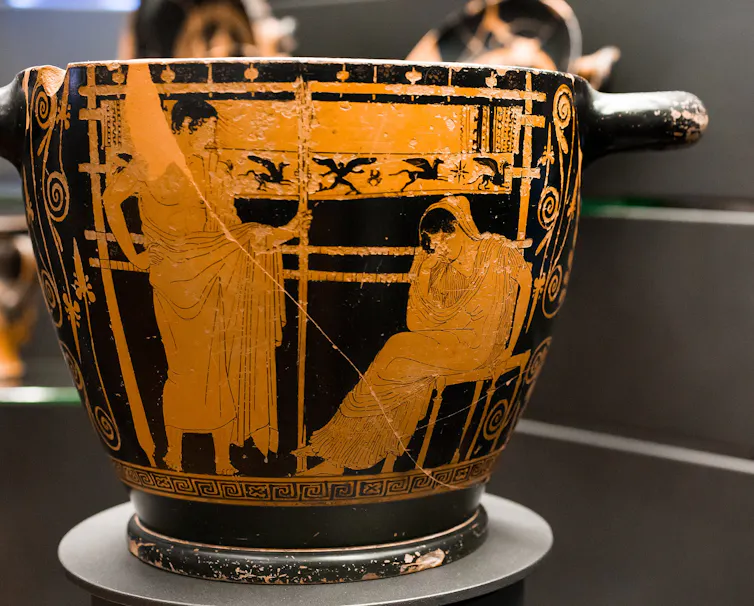
Her role as a faithful wife and dedicated mother are pivotal to Homer’s Odyssey. Penelope at her loom has become shorthand for female sexual virtue, appearing in art from classical red-figure vase paintings to neoclassical portraits, like that of Angelica Kauffman (1741-1807).
Vase painting showing Penelope, seated mourning at her loom, with her son Telemachos.(Wikimedia/Museo archeologico nazionale di Chiusi), CC BY
Advertisement
In Nolan’s film, Penelope is never far from her loom. Significantly, one of the most important moments in Homer’s story is missing: her test of Odysseus after his return.
The Homeric Penelope wishes to verify Odysseus’ identity after his long absence. Knowing he carved their marital bed from a rooted olive tree, she tells a servant to make the bed up outside the bedchamber to see how Odysseus responds. He suspects she has been unfaithful until he learns the bed has remained fixed in place.
Her trick of the bed cements her as the equal of the polutropos man (“the man of many wiles”). But it also requires her to voice the possibility of her own infidelity.
Allison Glazebrook is Professor of Classics and Archaeology at Brrok
University. Her research relates to the social and cultural history of
ancient Greece, and focuses on women, gender, sexuality, and slavery.
She uses texts, vase iconography, and archaeological data to explore
these topics. Her latest book is Sexual Labor in the Athenian Courts (2021).






 reddit this
 Del.icio.us
 Seed Newsvine
 StumbleUpon