Thailand on its own would not be able to bring the KLB to fruition. On the part of China, it can leverage SOEs and development banks to offer Thailand comprehensive financing and construction packages. By offering to integrate the KLB into the broader BRI, China will be able to connect the corridor with existing rail projects in all of Laos and Malaysia, thus creating a unified trade network.
When the commercial auction and bidding selections shift into the pipeline, China could launch aggressive bids for the management rights of the ports of Ranong and Chumphon to secure permanent logistics footholds at the interface of the Indian and Pacific Oceans. Further, Chinese industrial consortiums could partner with local Thai groups to not only establish manufacturing works within the new economic zones but also turn the isthmus into a processing zone for re-exporting goods into regional markets.
Meanwhile, the US could gather its entrepreneurial minds from equity firms, institutional investors, and commercial logistics entities and woo Thailand with high-end port automation software, cyber-secure tracking systems, and green energy logistics solutions. In addition, the USmight consider deepening its economic and security partnerships with Singapore and India to ensure that a northern bypass would not destabilize the security equilibrium or disrupt trade lanes in the wider Bay of Bengal and the Andaman Sea.
Advertisement
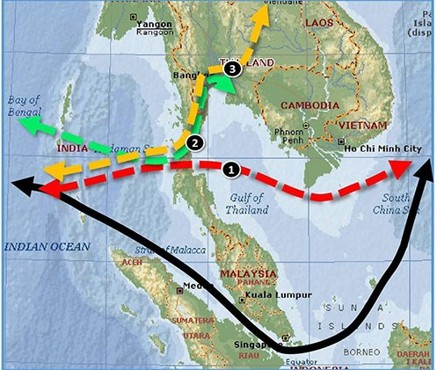
Then there are third-party endeavors, such as the Global Academy for Future Governance (GAFG), whose recently launched Global Maritime Governance Forum amplifies and advances its Connectivity Doctrine. This seeks to redefine global infrastructure as an interdependent governance ecosystem where rules replace piecemeal transit routes, bringing about an alignment of physical, regulatory, and institutional systems, while restoring coherence and predictability to increasingly disturbed global supply chains and the maritime traffic system.
As GAFG experts often observe: "If the Tibetan Plateau is Eurasia's backbone, the Strait of Malacca is its principal maritime artery". Hence, a viable 'cardiovascular' supplement to the Strait of Malacca would no doubt diversify global supply chains, protect East Asian economies from chokepoint Hormuz-like strokes (vulnerabilities), and spur regional growth. Yet, the future of this vital trade corridor hinges on how well the UScan leverage its technological and commercial advantages against Chinese economic statecraft to secure the broader Indo-Pacific - while challenging both actors to treat regulatory, physical, and transport layers as a single, unified governance ecosystem rather than isolated infrastructure projects.
Discuss in our Forums
See what other readers are saying about this article!
Click here to read & post comments.




 reddit this
 Del.icio.us
 Seed Newsvine
 StumbleUpon