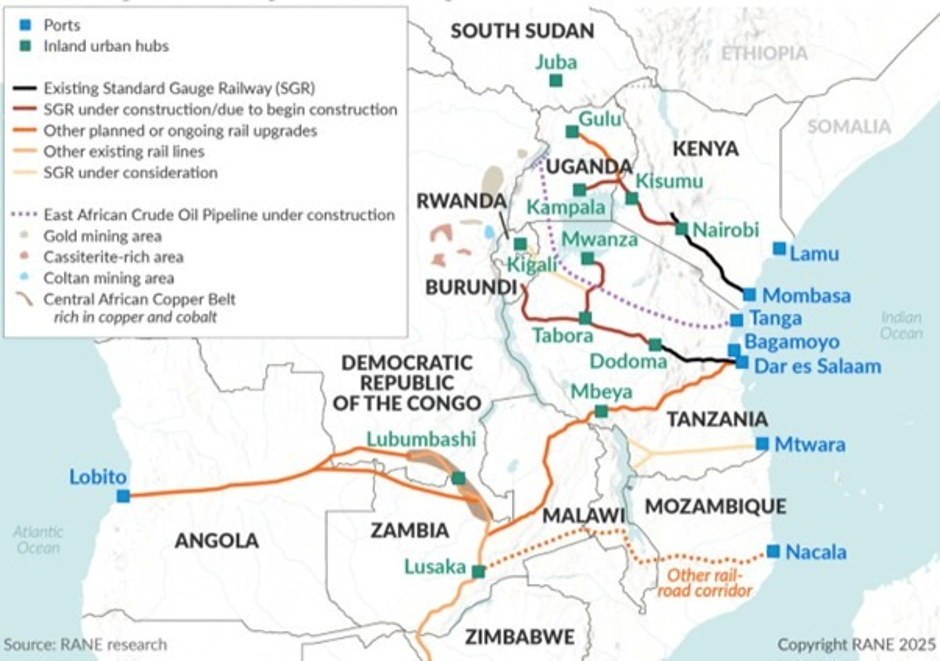
The twenty-first century is witnessing a profound reconfiguration of global trade routes. From the Arctic passages of the north to the Middle Corridor across Eurasia and the North-South Corridor connecting Russia, Central Asia, the Gulf, and India, nations are increasingly investing in alternative corridors that can reduce dependency, diversify supply chains, and strengthen economic resilience. Africa, long perceived as peripheral to these developments, is now emerging as one of the most consequential arenas in this global transformation.
At the center of this emerging story stands East Africa and, in particular, Tanzania's ambition to become a strategic Afro-Asian gateway through the Indian Ocean.
Advertisement
The proposed Bagamoyo Port, located north of Dar es Salaam, represents one of the most ambitious infrastructure projects on the African continent. Conceived as a deep-water maritime hub supported by China and the Sultanate of Oman, Bagamoyo is designed to complement the Port of Dar es Salaam while significantly expanding Tanzania's capacity to serve international trade. Combined with the modernization of transport infrastructure and the revitalization of the Tanzania-Zambia Railway Authority (TAZARA), the project has the potential to transform East Africa's role in global commerce.
The significance of such developments extends far beyond Tanzania. Across the world, alternative corridors are increasingly viewed as instruments of geopolitical influence and economic security. As the International Institute IFIMES observed in its periodic analyses of Eurasian connectivity, "roads are the arteries of economic progress" – and often published by this very magazine. The institute further noted that emerging transport corridors are "not merely an economic prospect – they are transformative forces capable of changing powers and roles in the international system."
Africa today finds itself at a similar historical juncture.
For decades, much of the continent's transport infrastructure reflected colonial-era priorities, linking mines and agricultural zones to coastal export terminals. While these networks facilitated extraction, they did little to encourage regional integration or industrial development. The new generation of corridors seeks to reverse that logic. Rather than serving as channels for exporting raw materials alone, they are increasingly envisioned as platforms for manufacturing, logistics, technology transfer, and regional economic cooperation.
The intellectual foundations for this transformation have been explored extensively by Prof. Dr. Anis H. Bajrektarevic. In his book Europe and Africa: Similarities & Differences in Security Structures, co-authored with Giuliano Luongo, he argues that connectivity and regional integration constitute fundamental prerequisites for sustainable development and security. The work highlights how infrastructure networks can help overcome fragmentation, strengthen state capacity, and promote economic stability across regions that have historically faced structural disadvantages.
This perspective is particularly relevant to East Africa. Tanzania's geographic position offers exceptional advantages. With direct access to the Indian Ocean and transport links extending toward Zambia, Malawi, Rwanda, Burundi, Uganda, and the eastern regions of the Democratic Republic of Congo, the country is uniquely positioned to become a bridge between African resources and Asian markets.
Advertisement
The TAZARA railway illustrates this strategic potential. Constructed during the 1970s with Chinese support, the railway was originally intended to provide Zambia with an alternative route to the sea independent of apartheid-controlled Southern Africa. Today, the same railway can serve a new purpose: connecting the mineral-rich heartlands of Central and Southern Africa to one of the fastest-growing economic regions in the world.
This connection is becoming increasingly important as Asian demand for critical minerals continues to expand. The global transition toward renewable energy technologies, electric mobility, and advanced manufacturing requires vast quantities of copper, cobalt, nickel, lithium, graphite, and rare earth elements. Many of these resources are found in Africa. Efficient transport corridors can therefore determine not only how quickly these resources reach global markets but also whether Africa captures a larger share of the value chain through local processing and industrialization.
As the Institute has argued in its broader studies of global connectivity, canals, roads, railways, and corridors are more than engineering projects. They are mechanisms through which nations "connect and overcome natural limits, changing history." This observation resonates strongly with the emerging Indian Ocean corridor, where infrastructure is beginning to alter the economic geography of an entire region.




 reddit this
 Del.icio.us
 Seed Newsvine
 StumbleUpon