As reported by Business Day, COP29 cost the Nigerian government N866 million (approx. $600,000 USD) in flight costs alone, with 634 delegates attending. Ministers attending are paid $900 per day, which comes $11,700 each for the 13-day conference. Permanent secretaries are paid $600 per day, amounting to $7,800 for the same period. Even those supporting the climate scare have said that, "Nigeria's delegation to COP29 could have been substantially reduced while maintaining effective representation" and that "The funds spent on COP29 delegates could directly support community-led initiatives addressing climate-related challenges locally." Regardless of one's views on climate change, these expenses are extravagant, especially for a developing nation, and we can all agree that the funds would have been better spent elsewhere: adapting to climate change should be a priority, for climate change is natural and will always happen. Building resilient infrastructure and communities is thus key for ensuring a country's prosperity.
The Australian governmentspent almost A$1.7 million (approx. $1.1 million USD) to send their 75 bureaucrats and 2 ministers to COP29. This has also been heavily criticized, for instance, by shadow finance minister James Patterson, who said that the Labour government has been "spending extravagant sums of taxpayers' money on climate junkets." Australia also spentA$871,000 (approx. $570,000 USD) at COP29 for a pavilion to share "stories of Australian climate action."
Fiji spentFJ$1.2 million (approx. $500,000 USD) to send their 56-member delegation to COP29, and Pakistan spentover $1 million USD to send their 35-member delegation.
Advertisement
Although Canada has not released their expenses for COP29, we can get an idea of their expenditures by looking at the 2023 conference. At the COP28 conference, Canada spent $1.4 million CAD (approx. $1 million USD) to send 633 delegates to Dubai, even more than the US under Biden, which included transportation, accommodations, meals, and incidentals. This included no less than 114 federal employees. In addition, the government put $1.3 million CAD (approx. $0.9 million USD) toward a Canada Pavilionto "showcase the breadth of Canadian climate leadership." The total cost for Canada's participation in the meeting was over $2.1 million USD.

The U.S. has apparently not released their expenses for past COP conferences, but we can determine a rough estimate for COP28 based on Canada's numbers. The U.S. sent 405 delegates, again on Joe Biden's watch, which is about 64% of the number of delegates sent by Canada, and also had a USA Pavilion. Assuming that the delegates stayed at similarly priced hotels and that transportation costs were comparable, this would lead to a total $1.3 million USD.
Happily for the American taxpayer, the Trump administration decided that no top White House officials or negotiatorswould fly to Brazil for COP30. In addition, neither Trump, nor any of his people, attended the leaders' summit ahead of the main conference in Belem. Yet, while Trump's administration sensibly ignored the summit, over 100 state and local U.S. leaders - including governors and mayors of towns and cities - were still expected to attend CP30.
Of course, none of these expenses are even remotely necessary. There is no climate emergency, so each country is spending millions of dollars annually to attend nothing but a bureaucratic charade. Bill Gates' recent statementthat climate change "will not lead to humanity's demise" is a step in the right direction, especially given his extreme views on climate change in the past. His statement that "It's time to put human welfare at the center of our climate strategies" is certainly reasonable, for we should always help people adapt to climate change. He goes on to say that "Our chief goal should be to prevent suffering, particularly for those in the toughest conditions who live in the world's poorest countries."
However, Gates still supports the mistaken idea that climate change is caused mostly by humans and is a serious problem, so these statements, although a step in the right direction, do not mark as critical a turning point as many believe. Indeed, he says in the same memo that "Climate change is a very important problem…Every tenth of a degree of heating that we prevent is hugely beneficial because a stable climate makes it easier to improve people's lives" and further details how "renewable" technologies can help achieve this goal. The climate alarmist narrative is dampened, but it is still very prevalent in his outlook.
Advertisement
In the UN's recent press release in preparation for COP30, "Climate and Nature Solutions," Catherine McKenna, former Canadian environment minister, now Chair of the UN's High-Level Expert Group on Net-Zero Emissions Commitments of Non-State Actors, pushed for companies and cities to commit to Net-Zero emission goals and detailed a framework to hold them accountable. She said that "83 percent of the global economy is covered by net zero commitments" and that we must "accelerate climate action."
So, although the tide turning, it hasn't yet reached its peak before an inevitable decline. Using a very simplified illustration, the trend could look something like this:
The Rise and Fall of Climate Alarmism
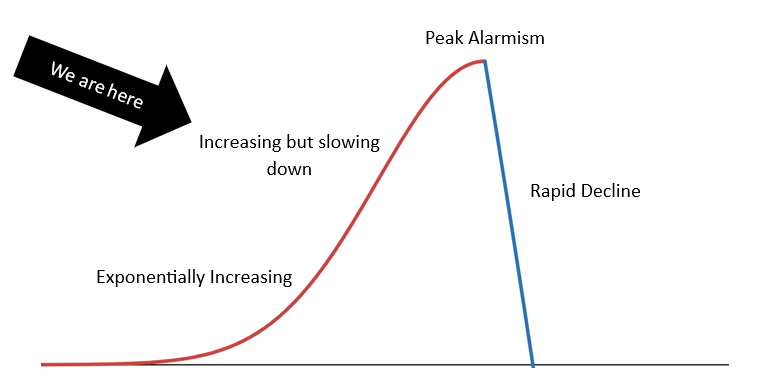
Climate alarmism still rising, at least outside of the U.S. federal government. But change is in the wind, and Net-Zero projects will, hopefully sooner rather than later, become an embarrassment of the past. Then the real "stranded assets" will be expensive, inefficient, and environmentally damaging wind turbines, solar power plants, and massive Battery Energy Storage Systems.
Let's hope that President Trump's realistic view of climate change will help the alarmist narrative crumble and that COP30 may indeed be one of the last such hypocritical, expensive, and useless gabfests. The death of climate change alarmism cannot happen soon enough.




 reddit this
 Del.icio.us
 Seed Newsvine
 StumbleUpon


