The poorer regions of the world are catching up with the richer regions in terms of living standards and basic education levels, which in turn reduces their fertility levels. As a result, the runaway global population we were invited to worry about as children is no longer a realistic worry. Despite a recent reduction in life expectancy in some regions due to lockdowns and Covid vaccines, humanity as a whole is still on a longer-term trajectory of living longer and getting healthier.
New geopolitical power blocs are forming that provide a counterweight to the US and the West, promising a more balanced future wherein no country or bloc of countries can boss the rest of the world around. While the transition phase toward that longer-term balance is fraught with dangers, the longer-term political picture looks navigable.
In sum, the world is more fertile and the basic conditions for human thriving (water, food, energy, and power balance) are looking favourable. Put in perspective, the worries of our generation (fascism, neo-feudalism, nuclear wars, totalitarianism) would seem but blips towards a bright future, just as WWI and WWII proved little more than local skirmishes in the longer-run forward striding of humanity as a whole.
Advertisement
Over the next 80 years, what do we expect? Consider the growth predicted for leaf coverage, which is shorthand for 'food and diversity abundance,' from 2081 to 2100:
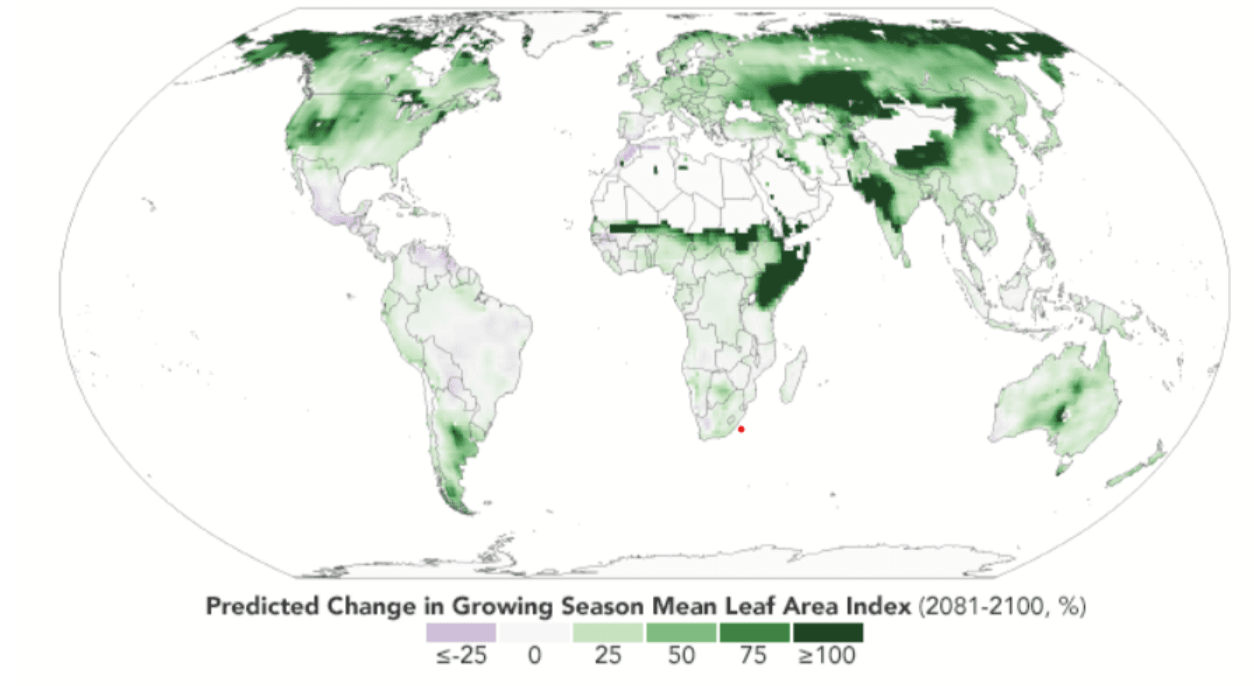
Large areas of the world, including the most populous ones, are predicted to double their plant life over the next 80 years. Every human who steps into a car or plane with a combustion engine is contributing to this future.
On the scale of humanity as a whole, we have done great and we are still looking good for at least as long as the lifetimes of our children. Even the last 5 years saw net progress: the destruction caused by lockdowns and Covid vaccines does not take away from the upward trajectory of the number and longevity of all humans on the planet.
We estimate that something on the order of 60 million people needlessly died or were prevented from being born because of lockdowns and vaccines, but some 400 million new humans were born anyway in the last 5 years, increasing the world's population by about 200 million. Incomes and consumption even increased in poorer regions, like India and Southeast Asia.
Wars would have to be far worse than WWII to make a dent on these broad positive trends. They would have to be worse than a minor nuclear exchange. The current conflicts in Ukraine, Palestine, and elsewhere are just not deadly enough to be noticeable at the world level. While every death is tragic, humanity as a whole will continue to thrive in spite of present conflicts.
Advertisement
The world as a whole is doing fine, in sum. To widen our smile, let us name and acknowledge five Great Accomplishments of the West that we are honestly proud of, and feel honoured to cherish and defend in these times.
- The brilliant invention of the separation of powers. Everywhere in the West, you see the belief – and sometimes the practice – of a separation of powers. No other culture hit upon this idea, and powerful people everywhere hate it because it limits them, which is why it is so infrequently practiced. Despite being universally hated by powerful people and quite absent de facto from most of the West today, the idea is alive and well. Everyone in the West seems to believe in it in their hearts. It is in all our books on the benefits of democracy, and in all the stories we tell ourselves and our children about how our modern societies function. After the current round of neo-feudalism by those in power is over, we expect this idea to be implemented once again: the West will return to pitting groups of powerful people against each other as the winning method for keeping the powerful in check. Incidentally, we think that this idea should be taken further: that national power should be split into four rather than three parts. An active citizenry is needed to keep the executive, the legislative, and the judiciary de facto separated and informed. Rather than the corporate media as a viable "fourth estate," we see active citizens as the fourth power needed to keep the other three powers apart by appointing top public-sector officials and judges, through a citizen jury system. This fourth power of citizens should also become what modern media companies are not, by providing the population with citizen-gathered information to keep the citizenry and the three other powers independently informed.
- Hitting upon the huge gains available from investments in, and harvesting of, diversity in science, markets, and large organisations. The great trick of the human body is to harvest the efforts of thousands of different species in our bodies without having the body overwhelmed. We use other species to digest food, keep our skin supple, optimise our teeth and internal lubricants, and so forth. The West has hit upon the same trick in its methods of societal organisation, via competitive markets wherein different people and their organisations go in totally different directions, finding out experimentally who has the better ideas that benefit all of society. Western scientific knowledge too has come from lots of scientists trying different things, with the users of science slowly (often painfully slowly, as in, over many decades) finding out who was less wrong than whom. Large Western organisations sow and harvest diversity within themselves too, via functional divisions, R&D units that stimulate diversity, and an internal tolerance for experimentation by many managers who draw on the resources of the whole.
- The universality of Western artistic expression. Today's woke, self-obsessive norms notwithstanding, top art in the West openly tries to step away from the present and the local and speak to humanity as a whole. We do this in music, sculptures, paintings, architecture, poetry, and books. To be fair, Buddhism also tries to do this, and much of the rest of the world does this in some of its artistic forms (most often in architecture and sculptures, and sometimes in great epic stories) but the West has made it an artistic philosophy to aspire to step out of "here today" and speak to everyone, everywhere, across time.
- The offer of grace. The great gift of Christianity to the West has been the idea of grace, inclusive of mercy and benign tolerance for human 'weaknesses.' Most other cultures and even some strands of Christianity do not adopt this forgiving, compassionate attitude. The true humanistic perspective in which we lovingly embrace our own natures and our mortal enemies as simply human – warts and all – is not only kind, but offers people the emotional security needed for self-love, honest self-reflection, development, and self-improvement.
- The creation of public spaces where the heart and the mind can speak. From village squares to town markets; from happy hour after work to parent night at school; from museums of art to public footpaths in the city centres; from interruption microphones at conferences to debating societies in academia: Western people consciously create space for citizens to speak their minds and display their hearts. As with the separation of powers, the present weakness of implementation of this phenomenon does not diminish the continued potency of the idea. Abusers of power often shut down public spaces to prevent open dissent, but the idea that we should have such spaces is alive and well in the West. Even the totalitarians in charge know that their intolerance has taken over and hope for a future in which the open spaces are again truly open (i.e., once everyone agrees with them, out of their own volition naturally!).
Of course, the West is no stranger to all the ills of humanity, from industrialised murder of the enemy to institutionalised oppression of its own population. Of course, Western culture and institutions owe a huge debt to non-Western cultures, with contributions ranging from the Chinese idea of a meritocratic bureaucracy to the useful plants of the Andes (potatoes, cacao, corn, etc.).
Discuss in our Forums
See what other readers are saying about this article!
Click here to read & post comments.
5 posts so far.
About the Authors
Gigi Foster is a Professor
of Economics at the University of New South Wales, Australia. Her
research covers diverse fields including education, social influence,
corruption, lab experiments, time use, behavioral economics, and
Australian policy. She is co-author of The Great Covid Panic.
Paul Frijters is an economics professor at the Queensland University of Technology.
Michael Baker has a BA (Economics) from the University of Western Australia. He is an independent economic consultant and freelance journalist with a background in policy research.




 reddit this
 Del.icio.us
 Seed Newsvine
 StumbleUpon
 Gigi Foster
 Paul Frijters
 Michael Baker


